Transparency Center¶
A Transparency Center is a dedicated web portal serving as the single authoritative source for all privacy-related information. It consolidates privacy notices, rights portals, contact information, and vendor disclosures into one accessible location, reducing friction and building user trust.
Overview¶
Privacy regulations increasingly require organizations to provide accessible, clear information about personal data handling. Rather than embedding privacy information across multiple pages, a dedicated Transparency Center improves user experience while demonstrating compliance commitment.
Core components¶
Privacy Notice¶
The foundational document explaining data handling practices:
Essential Sections: - Organization Identity: Name, address, DPO contact - Data Collection: What data is collected and how - Use & Purpose: Why data is collected and how it's used - Legal Basis: Which lawful basis applies to each processing activity - Data Retention: How long data is kept before deletion - Recipients: Third parties who access personal data - Data Subject Rights: How to exercise access, rectification, erasure, etc. - Complaint Procedures: How to escalate concerns to regulators - Contact Information: DPO, privacy team, and support channels
Cookie Notice¶
Transparent disclosure of tracking technologies with clear consent buttons (accept, reject, customize) and granular controls for cookie categories.
Data Subject Rights Portal¶
Centralized access point for exercising privacy rights:
Available Rights Options: - Right of Access: Request copy of personal data - Right to Rectification: Correct inaccurate information - Right to Erasure: Request deletion of data - Right to Restrict: Limit how data is processed - Right to Data Portability: Obtain data in machine-readable format - Right to Object: Opt-out of processing - Consumer Rights: Opt-out of sale/sharing (CCPA/CPRA)
Contact Information¶
Clear pathways for user inquiries including privacy team email, support form, and mailing address for formal requests.
Jurisdiction-Specific Statements¶
Customized information for users in specific regions (GDPR, CCPA/CPRA, PIPEDA, PDPA, APPI, Brazil LGPD).
Vendor & Sub-Processor List¶
Transparency about third parties accessing data with processor information, categories of personal data processed, and security measures implemented.
Building your Transparency Center¶
Step 1: Review your Transparency Center¶
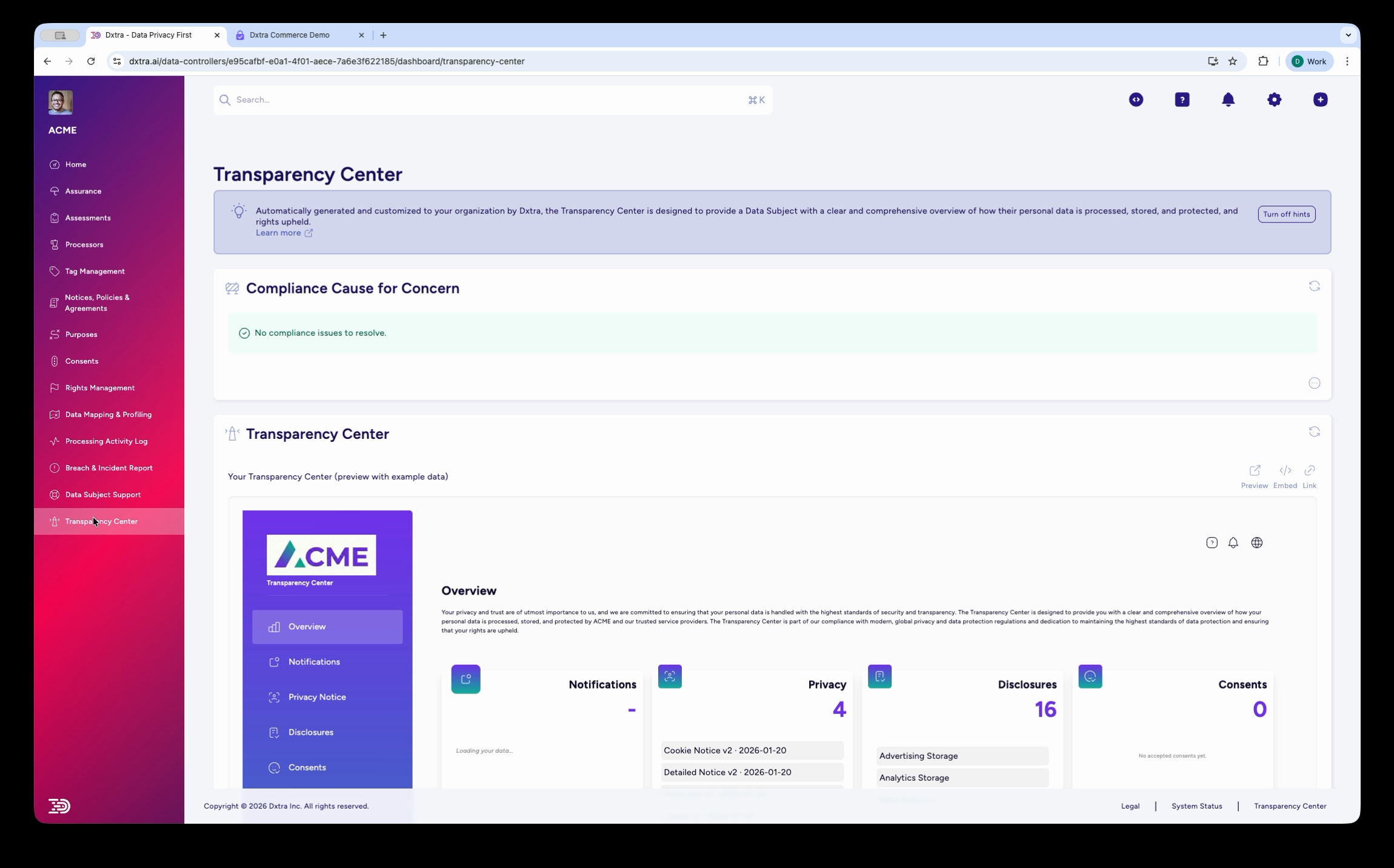
The Transparency Center admin page showing a preview of your published portal. The embedded preview displays the "ACME" branded Transparency Center with an Overview tab selected, showing summary tiles for Notifications, Privacy, Disclosures, Consents, and navigation tabs on the left (Overview, Notifications, Privacy Notice, Disclosures, Consents).
Navigate to Transparency Center in the sidebar. The admin page shows a live preview of your Transparency Center as data subjects see it, generated with example data. Review the overview tiles showing notification counts, privacy documents, disclosures, and consent categories.
Step 2: Customize content and settings¶
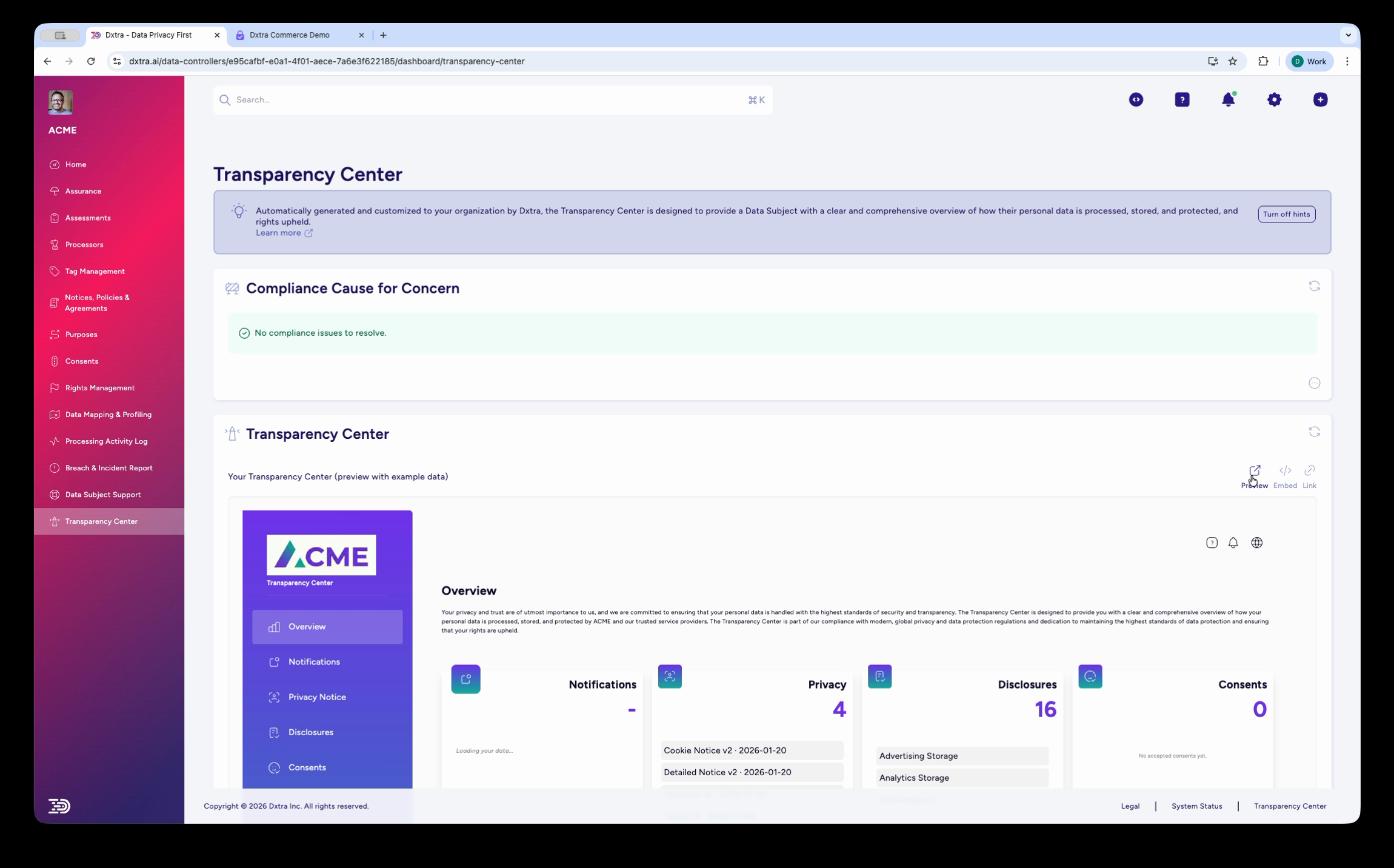
The same Transparency Center admin view with the portal preview. Use the toolbar icons above the preview (edit, settings, refresh) to customize the portal content, branding, and language settings.
Configure the appearance, language support, and content sections. Have legal review all notices and disclosures before publication.
Step 3: Data subject authentication¶
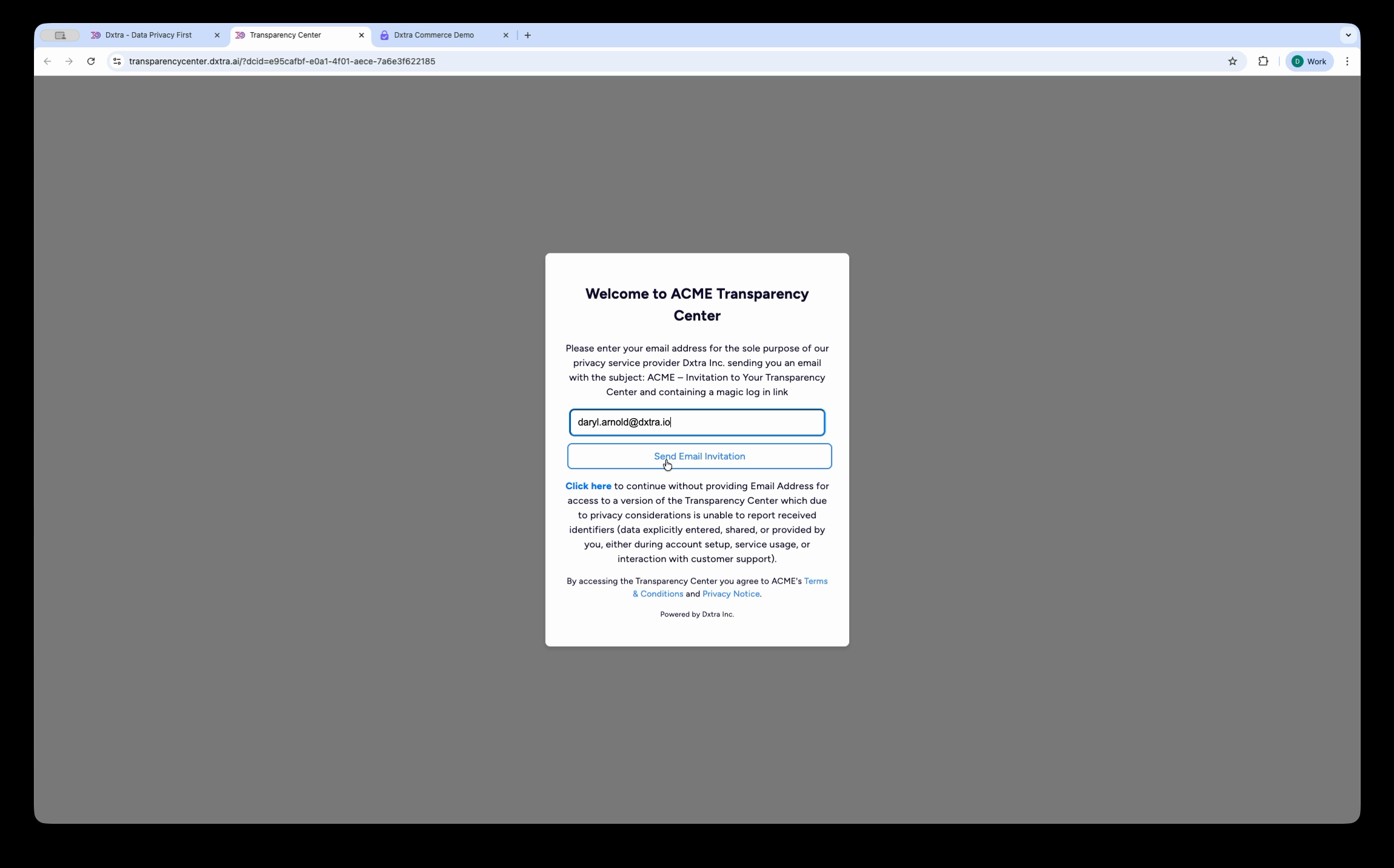
The data subject-facing Transparency Center login page at transparencycenter.dxtra.ai. A modal dialog shows "Welcome to ACME Transparency Center" with an email input field, a "Send Email Invitation" button for magic link authentication, and a note about accessing a limited version without providing an email address. Terms, Conditions, and Privacy Notice links appear at the bottom.
Data subjects authenticate via magic link email to access the full Transparency Center. Those who prefer not to provide an email can access a limited version of the portal.
Design best practices¶
Accessibility First: Test with screen readers and keyboard navigation. Ensure readability for non-native speakers. Use clear headings, sufficient color contrast, and descriptive link text.
Mobile Optimized: Over 50% of users access on mobile. Design for small screens, touch interaction, and limited bandwidth. Test on actual mobile devices, not just browser simulations.
Privacy Protective: Don't collect unnecessary user data. Use minimal analytics. Avoid fingerprinting or tracking users across pages. Be transparent about any analytics you do use.
Legal Accuracy: Have legal review all notices before publication. Update immediately when practices or laws change. Maintain version history of all changes for audit purposes.
Usability Tested: Conduct user testing with representative data subjects. Validate that instructions are clear, workflows work smoothly, and users understand their rights and options.
Content governance¶
Update Triggers: - Policy or practice changes (data retention, retention procedures, new uses) - New data processing activities (new tools, integrations, data sources) - Regulatory changes in target jurisdictions (new requirements or obligations) - Vendor or processor changes (new third parties or changes to existing vendors) - User feedback indicating confusion or unclear information
Regular Review Schedule: - Quarterly review of core content: Verify that all information remains current and accurate - Annual comprehensive audit: Full review against your actual practices, policies, and legal obligations - Triggered reviews when regulations change: Immediate review of sections affected by new legal requirements - Post-incident reviews: Update security and breach sections after any privacy incidents
Content Ownership & Responsibility: - Assign privacy officer as primary content owner - Designate editors for each major section - Require legal review before any publication - Maintain version control and change history - Document approval chain and dates
Why provide a Transparency Center¶
Regulatory Compliance¶
Privacy laws require clear, accessible information. Most major regulations explicitly mandate that organizations provide accessible, clear information about their data handling practices:
- GDPR: Articles 13-14 transparency requirements, right to information
- CCPA/CPRA: Mandatory disclosures and consumer rights notices, do-not-sell links
- PIPEDA: Collection notices and personal information handling requirements
- PDPA: Collection purpose disclosure and access procedures
- APPI: Purpose notification and protection notice requirements
- Brazil LGPD: Data processing transparency and controller identification
Building Trust¶
Transparent practices differentiate your organization from competitors. When users understand your data practices clearly and honestly, they appreciate the transparency and develop trust in your brand. This leads to:
- Improved brand reputation and customer loyalty
- Reduced privacy concerns and friction during signup
- Better retention as users feel respected and informed
- Demonstrated commitment to responsible data stewardship
Operational Efficiency¶
Centralized information reduces support burden significantly. Self-service access through a well-designed Transparency Center reduces the volume of privacy team inquiries by answering common questions upfront. This allows your privacy team to focus on complex requests and strategic compliance work.
Related pages¶
- Rights Management — Enable data subjects to exercise rights through your portal
- Data Subject Support — Provide extended support and FAQs
- Data Mapping & Profiling — Inform disclosures about data handling
- Security & Breach reporting — Update transparency regarding security measures
Ensure your Transparency Center meets transparency requirements under GDPR Articles 13-14, CCPA §1798.100, PIPEDA Schedule 1, PDPA §22, and APPI Articles 6-7.